
Policy-oriented research on population trends
ESCAP publishes reports, working papers, policy briefs and other material analyzing population trends and their policy implications in the Asia-Pacific region. The publications will guide policymakers and all stakeholders.
Latest Publication
Leaving No One Behind: Advancing a Society for All Ages in Asia and the Pacific
This report examines the demographic drivers reshaping the region, analyses the implications for labour markets and the future of work, and highlights the transformative potential of healthy and active ageing. It documents the substantial economic contributions of older persons — through labour, entrepreneurship, unpaid care and social capital — and makes the case for urgently realigning employment systems, social protection and health policies with demographic realities. The report also explores pathways to women’s economic empowerment, recognizing that gender inequality compounds the vulnerabilities of ageing across the life course.
Publications

ESCAP population data sheet 2025
The Population Data Sheet, published annually by ESCAP, features a range of key indicators on population and development. The focus is on population size, structure and growth rates, as well as fertility, mortality and migration, at country, subregional and regional levels. The Data Sheet is a useful reference tool for researchers, policymakers and other stakeholders. The 2025 Population Data Sheet focuses on overall population and development indicators, providing updated insights for the year.
Population Ageing in the Asia-Pacific Region and its Economic and Intergenerational Consequences
Asia and the Pacific is a region of very significant geographic, social, economic and demographic
diversity. Some countries have large and growing youthful populations, and, with investments in
education and health, can still benefit from the demographic dividend of the demographic
transition. Many other countries have already been affected by significant and rapid population
ageing. Moreover, even the “oldest” countries will experience substantial further ageing in the
coming decades, while all countries will eventually reach a point in which population ageing is likely
to pose large socioeconomic costs. These need to be better understood in order to mitigate
impacts and even gain benefits from having larger proportions of older populations.
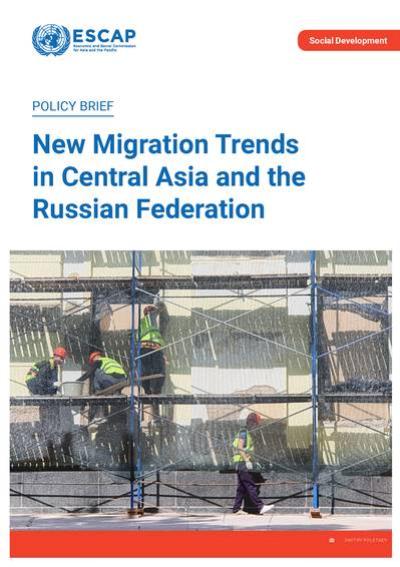
New Migration Trends in Central Asia and the Russian Federation
Migration is a crucial factor in economies and societies in North and Central Asia. In 2024, over 6.3 million people born in Kazakhstan, Kyrgyzstan, Tajikistan, Turkmenistan and Uzbekistan were living in countries other than their countries of their birth.
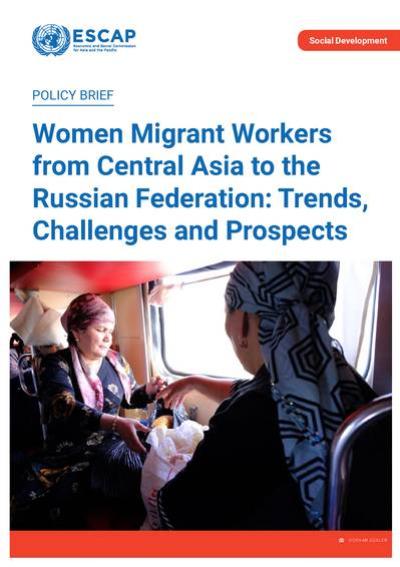
Women migrant workers from Central Asia to the Russian Federation : trends, challenges and prospects
The Russian Federation remains a key destination of migrants. In 2024, the Russian Federation hosted 7.6 foreign born people, among them 3.8 million women and 3.7 million men.
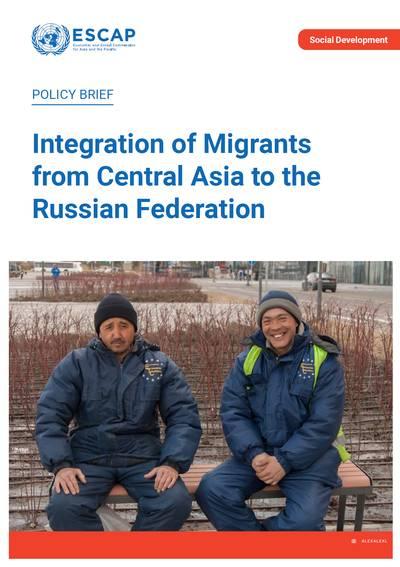
Integration of migrants from Central Asia to the Russian Federation
This policy brief is based on an unpublished working paper on “Integration of migrants from Central Asia in the Russian Federation”, commissioned by ESCAP. The working paper utilized survey data from five studies conducted by the author (2015, 2016, 2017, 2020, and 2023), each with similar but not identical methodologies and different research focuses. The objective of this policy brief is to highlight the status of migrant worker integration in the Russian Federation and provide summary conclusions. The focus is on migrant workers from Kazakhstan, Kyrgyzstan, Tajikistan and Uzbekistan.

Asia-Pacific sustainable development journal. Vol. 32, No. 1, April 2025
The focus of this issue of the Asia Pacific Sustainable Development Journal (APSDJ, Vol. 32, Issue 1) is the demographic transition in Asia-Pacific countries and its intergenerational implications. The theme is very timely as countries in Asia and the Pacific – home to close to 60 per cent of the world’s population – are experiencing a rapid demographic transition.
Events
Fifth Asia-Pacific Review and Appraisal of the Madrid International Plan of Action on Ageing: Briefings of focal points on ageing in North and Central Asia
Blogs and Op-eds

Building a future-ready society so people can live long and age well

Strengthening social health protection for health coverage for all ages