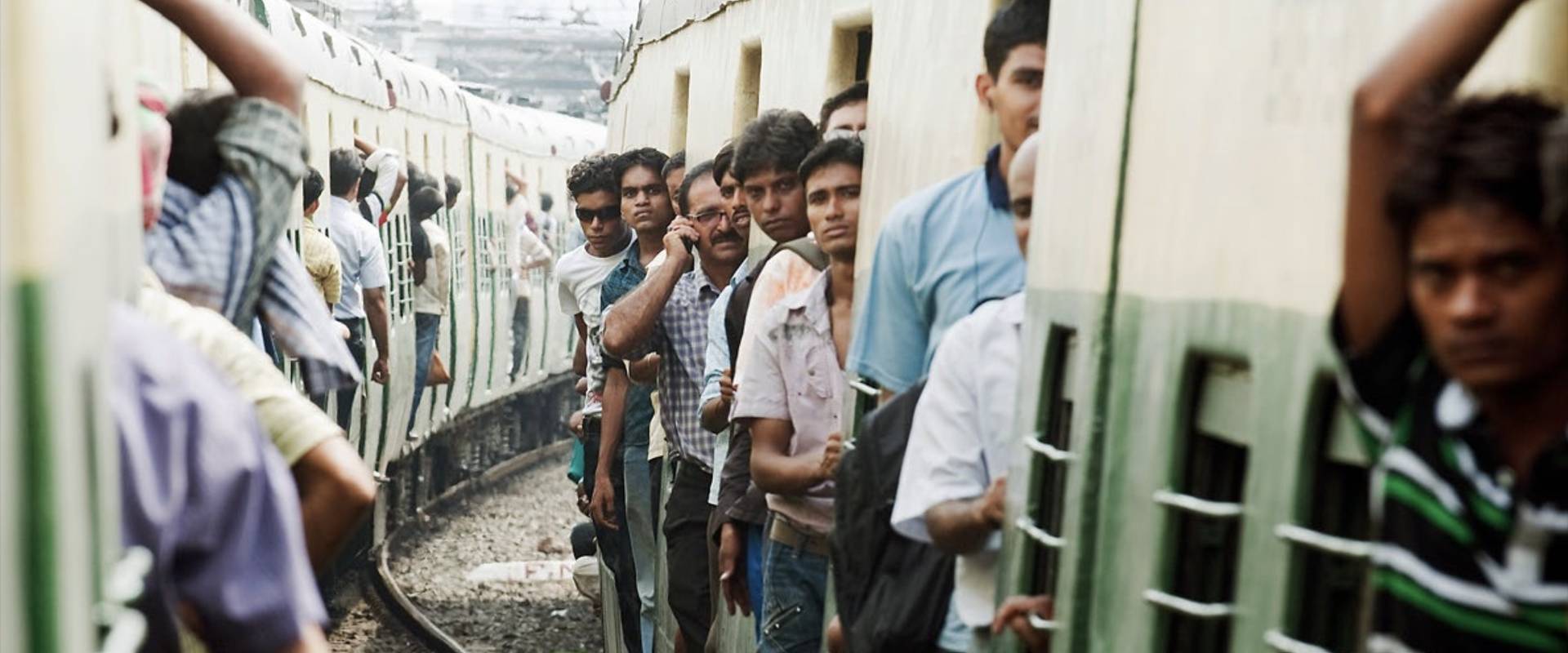
Policy-oriented research on population trends
ESCAP publishes reports, working papers, policy briefs and other material analyzing population trends and their policy implications in the Asia-Pacific region. The publications will guide policymakers and all stakeholders.
Latest Publication
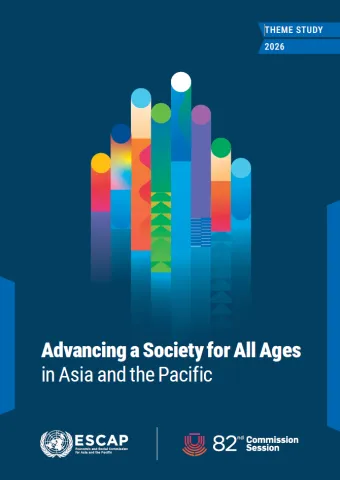
Leaving No One Behind: Advancing a Society for All Ages in Asia and the Pacific
This report examines the demographic drivers reshaping the region, analyses the implications for labour markets and the future of work, and highlights the transformative potential of healthy and active ageing. It documents the substantial economic contributions of older persons — through labour, entrepreneurship, unpaid care and social capital — and makes the case for urgently realigning employment systems, social protection and health policies with demographic realities. The report also explores pathways to women’s economic empowerment, recognizing that gender inequality compounds the vulnerabilities of ageing across the life course.
Publications
Building Social Welfare Interventions in China: Evidence from National Inclusion Account Estimates
China’s recent economic transformation has brought prosperity but also challenges in addressing inequality. To counter disparities, the government expanded its role in the economy and invested in social welfare. Education reforms ensured nine years of compulsory schooling, expanded higher education enrolment tenfold and strengthened vocational training. Healthcare coverage went from limited access in the early 2000s to near-universal insurance by 2024, while pension schemes now cover over 95 per cent of the population. Between 2010 and 2014, public spending on education, healthcare and pensions more than doubled, narrowing gaps across income groups.
National Inclusion Accounts in the Context of the Intergenerational Economy in Asia and the Pacific: Case Studies from Lao's People Democratic Republic, Maldives and Viet Nam
With significant increases in life expectancy across the Asia-Pacific region, more people of different age groups now live and interact together for longer than ever before, reshaping both opportunities and challenges for intergenerational solidarity. This intergenerational reality is at the heart of what national transfer accounts (NTAs) measure – the flows of resources between generations. Building on the NTA methodology, national inclusion accounts disaggregate economic flows, not only by age, but by income group, education level and family structure. In this paper, the analysis of three countries with available data in Asia and the Pacific (Lao People’s Democratic Republic, Maldives and Viet Nam) shows who within each age group actually benefits from public spending on education, health and pensions – and whether public programmes are reducing inequality or reinforcing it. These findings have implications for other countries in Asia and the Pacific, given persisting inequalities across the region. The paper concludes by calling for promoting equity across both generations and social groups, through an overall life-course approach to policymaking, focusing on access/coverage and quality, public/private partnerships and regional cooperation.

Closing the Grey Digital Divide: Boosting Digital Literacy for Older Persons in Asia and the Pacific
Asia and the Pacific is experiencing two concurrent megatrends: rapid population ageing and accelerating digital transformation. In 2026, the region is home to 530 million people aged 65 years or over, representing 11.0 per cent of the total population. By 2050, the number of older persons is projected to almost double to 996 million, representing 19.4 per cent of the total population. At the same time, digital technologies are transforming the way societies function – from accessing government services and health care to managing finances and maintaining social connections. As more services move online, older persons who lack digital literacy skills risk being left behind. This “grey digital divide” threatens social inclusion, limits access to essential services and deepens existing inequalities.

Strengthening Health Systems in Sri Lanka: Current Socioeconomic Developments with Special Emphasis on Population Ageing, Climate Change, Disasters and Technological Advancements
This paper explores the current situation, and ways forward to strengthen health systems in Sri Lanka in the context of population ageing, climate change, disaster preparedness and investing in technology solutions for health.
Strengthening health systems in Bangladesh: addressing emerging challenges and sociodempgraphic shifts
Bangladesh has made significant progress in public health, including reductions in maternal and
child mortality and increased immunization coverage. However, the health system faces growing
challenges due to population ageing, urbanization, non-communicable diseases, climate change,
and ongoing inequities in access and funding. These challenges are particularly pronounced for
older persons, women and socioeconomically marginalized populations, who experience
compounded vulnerabilities across the life course. This paper aims to examine these emerging
issues and their effects on health system performance, while identifying strategic policy priorities
to enhance resilience, equity and efficiency.
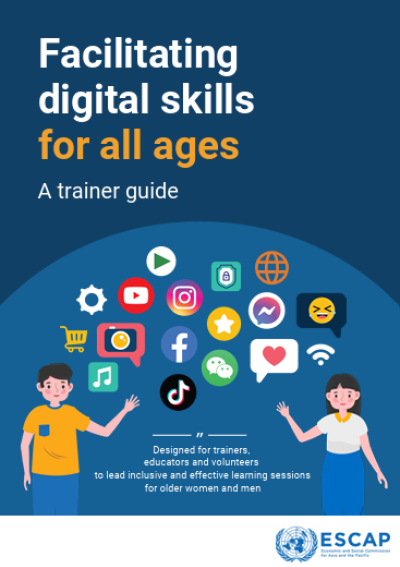
Facilitating digital skills for all ages: a trainer guide
This trainer guide has been developed to support facilitators, trainers, community educators and partner institutions in delivering inclusive and effective digital literacy training for older persons in Asia and the Pacific. As part of ESCAP digital literacy toolkit, and designed to complement the accompanying video series, the guide provides practical guidance on how to organize, adapt and deliver learner-centred training in diverse community contexts. It promotes participatory, respectful and age-responsive approaches that value the experiences of older learners while addressing common barriers to digital engagement, including low confidence, limited prior exposure and concerns about safety or relevance. The guide offers facilitation strategies, session structures, teaching tips and suggestions for creating supportive learning environments that encourage interaction, practice and peer learning.
Events
Asia-Pacific Regional Conference on Population Ageing 2026
South and South-West Asia - Stakeholder Consultation for the Asia-Pacific Fifth MIPAA Review and Appraisal
South-East Asia - Stakeholder Consultation for the Asia-Pacific Fifth MIPAA Review and Appraisal
Blogs and Op-eds

National inclusion accounts: a tool to promote intergenerational equity

Growing older, staying connected in the digital age