Youth play a key role in strengthening intergenerational relations across age cohorts
As Asia-Pacific countries transition from high to low fertility and mortality levels, their population age structures change. In the 1950s, the region’s number of children (aged 0—14) and working-age people (aged 15—64) began to rise. The number of children peaked in the mid-1990s, followed by general decline, while the number of working-age people will peak in the mid-2030s. The number of young people (aged 15—24) increased from 277 million in 1950 to 715 million in 2024 and is projected to decline to 589 million by 2050. In contrast, the number of older persons (aged 65 or above) has grown since the 1950s and is projected to go from 503 million in 2024 to 996 million in 2050, about three and a half times the number of children under age five.
The demographic transition and related age structure changes affect all Asia-Pacific countries. Although the onset, duration, speed and impacts vary by country and subregion, fundamental changes are occurring. Never before in history have so many people of different ages been living together.


Mandates
The World Programme of Action for Youth (WPAY), adopted by the General Assembly in 1995, provides a policy framework and practical guidelines for national action and international support to improve the situation of young people around the world. The WPAY covers fifteen youth priority areas and contains proposals for action in each of these areas.
At the Summit of the Future, held in 2024, world leaders adopted the Pact for the Future - a commitment to building a safer, sustainable and inclusive world for future generations. This pact encompasses five key focus areas, including Youth and Future Generations. The actions under this theme prioritizing investments in the social and economic development of children and young people, promotion and protection of their human rights and enhancement of meaningful youth participation at national and international levels.
At the World Social Summit, held in 2025, governments adopted the Doha Political Declaration, and, among many other commitments, pledged to promote intergenerational solidarity, inclusive dialogue and social cohesion.
ESCAP includes youth and addresses the topic of intergenerational relations in its intergovernmental meetings and its research on social development.
ESCAP also supports the ECOSOC Youth Forum, held annually.
Youth Policy Toolbox

The Youth Policy Toolbox is a platform by youth, for youth and policymakers. It serves as a hub for sharing knowledge, experiences, and good practices in the Asia-Pacific region. The platform is regularly updated with videos and materials focused on youth engagement, employability and youth rights. The Youth Policy Toolbox highlights the importance of youth voices and empowers those advancing youth engagement. Key features of the Youth policy Toolbox include:
- E-Learning: Access courses on youth rights, employability, and participation.
- Meet the Youth: Understand youth perspectives and engagement strategies.
- Good Practices: Explore youth-led projects shaping policies worldwide.
- Resources: Find tools to support your own policy initiatives.

Publications
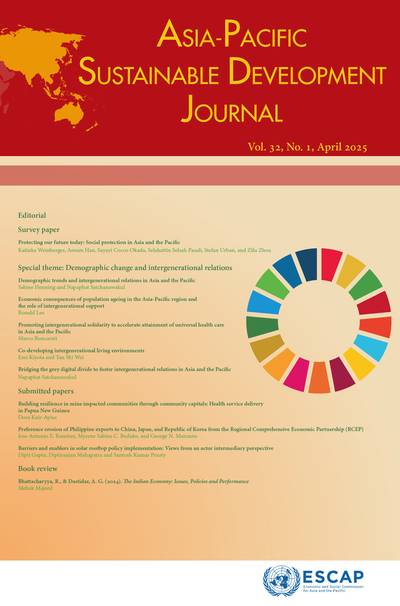
Asia-Pacific sustainable development journal. Vol. 32, No. 1, April 2025
1 April 2025
The focus of this issue of the Asia Pacific Sustainable Development Journal (APSDJ, Vol. 32, Issue 1) is the demographic transition in Asia-Pacific countries and its intergenerational implications. The theme is very timely as countries in Asia and the Pacific – home to close to 60 per cent of the world’s population – are experiencing a rapid demographic transition.
Demographic trends and intergenerational relations in Asia and the Pacific
1 April 2025
The demographic transition in Asia and the Pacific has resulted in rapid population ageing, smaller family sizes, more people living in urban areas and more migrants. Some of these changes are due to socioeconomic development.
Intergenerational relations: creating a world for all ages so that no one is left behind
30 September 2024
Populations globally are changing in fundamental ways. A result of the demographic transition, or the shift from high to low mortality and fertility rates, the slower population growth is accompanied by a shift in population age structures. Never before in history have so many people of different age cohorts been living together. This paper, prepared jointly by the five regional commissions of the United Nations, explores the social and economic challenges and opportunities of demographic shifts towards multigenerational societies across the countries covered by the five regional commissions.
Joint Expert Group Meeting on Older Persons and Intergenerational Solidarity
11 October 2023
Intergenerational solidarity is central to sustainability. In the 2030 Agenda for Sustainable Development, member States declared that they “are determined to protect the planet from degradation, including through sustainable consumption and production, sustainably managing its natural resources and taking urgent action on climate change, so that it can support the needs of the present and future generations.”
Videos


Youth Policy Toolbox – An Introduction

Faces of Youth in Asia and the Pacific
Events
Asia-Pacific Regional Conference on Population Ageing 2026
South and South-West Asia - Stakeholder Consultation for the Asia-Pacific Fifth MIPAA Review and Appraisal
South-East Asia - Stakeholder Consultation for the Asia-Pacific Fifth MIPAA Review and Appraisal
Blogs and Op-eds

National inclusion accounts: a tool to promote intergenerational equity

Growing older, staying connected in the digital age