
Policy-oriented research on population trends
ESCAP publishes reports, working papers, policy briefs and other material analyzing population trends and their policy implications in the Asia-Pacific region. The publications will guide policymakers and all stakeholders.

Latest Publication
Leaving No One Behind: Advancing a Society for All Ages in Asia and the Pacific
This report examines the demographic drivers reshaping the region, analyses the implications for labour markets and the future of work, and highlights the transformative potential of healthy and active ageing. It documents the substantial economic contributions of older persons — through labour, entrepreneurship, unpaid care and social capital — and makes the case for urgently realigning employment systems, social protection and health policies with demographic realities. The report also explores pathways to women’s economic empowerment, recognizing that gender inequality compounds the vulnerabilities of ageing across the life course.
Publications
Harnessing the second demographic dividend : population ageing and social protection in Asia and the Pacific
This paper explores key trends in population ageing in countries of Asia and the Pacific. It discusses how, through the right mix of institutional arrangements, policy initiatives and behavioural change, governments can address population ageing in order to achieve economic and social gains. The paper notes that, due to changes in the age structure, windows of opportunity might open for countries at different times. In this context, economic and social conditions linked to economic development, social protection investments and the robustness of the enabling environment for ageing well, constitute both prospects and resource constraints within each window of opportunity. The paper ends with conclusions and a series of policy recommendations aimed at managing ageing and ensuring sustained economic growth and greater social equity.
The Asian active ageing index : results for Indonesia and Thailand
This paper presents the Asian Active Ageing Index (AAI), with a focus on countries in South-East Asia, especially Indonesia and Thailand. It also seeks to recommend the Index for use by other countries of the Asian and Pacific region by adapting it to the Asia-Pacific context and taking into consideration factors such as the role of older persons in the society, changing norms and the informal nature of contributions of older persons to their families and communities. A review of the literature and various theoretical frameworks is presented to provide context to the development of the Asian AAI, while it is noted that the Asian AAI revisits the choice of indicators and revises the aggregation methods previously used in the European Union version of the AAI. Subsequently, the Asia AAI is explained, and the results are presented from applying it to Indonesia and Thailand across a wide array of parameters, yielding overall values as well as those specific to certain domains, such as such as employment, social participation and independent living. The paper concludes with a discussion on the Index and its application and a series of policy recommendations focusing on the domains of healthy ageing, financial security and enabling environment for active ageing.
ESCAP population data sheet 2020
The Population Data Sheet, published annually by ESCAP, features a range of key indicators on population dynamics- including population size and growth rates, fertility rate, life expectancy and age structure, at country, subregional and regional levels. It is a useful tool for reference by researchers, policymakers and other stakeholders active in the field of population and development.
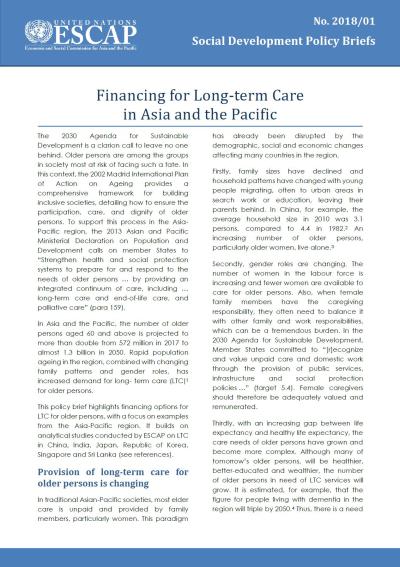
Financing for long-term care in Asia and the Pacific
The 2030 Agenda for Sustainable Development is a clarion call to leave no one behind. Older persons are among the groups in society most at risk of facing such a fate. In this context, the 2002 Madrid International Plan of Action on Ageing provides a comprehensive framework for building inclusive societies, detailing how to ensure the participation, care, and dignity of older persons. To support this process in the Asia-Pacific region, the 2013 Asian and Pacific Ministerial Declaration on Population and Development calls on member States to “Strengthen health and social protection systems to prepare for and respond to the needs of older persons … by providing an integrated continuum of care, including … long-term care and end-of-life care, and palliative care” (para 159).
In Asia and the Pacific, the number of older persons aged 60 and above is projected to more than double from 572 million in 2017 to almost 1.3 billion in 2050. Rapid population ageing in the region, combined with changing family patterns and gender roles, has increased demand for long- term care (LTC)1 for older persons.
This policy brief highlights financing options for LTC for older persons, with a focus on examples from the Asia-Pacific region. It builds on analytical studies conducted by ESCAP on LTC in China, India, Japan, Republic of Korea, Singapore and Sri Lanka
Long-term care of older persons in India
Older persons, particularly the oldest-old, are the fastest growing population segment in India and many of them require or will require long-term care in the future. The paper discusses policies on population ageing in India, such as the National Policy on Older Persons and the National Programme for Health Care for the Elderly. It further discusses the health status of older persons in India and projects future care needs. Finally, it discusses the prevailing provision of long-term care for older persons through the family as well as institutional care provided by the State, the private sector and civil society. The paper closes with policy recommendations.

Long-term care of older persons in Singapore : a perspective on the current delivery of health and long-term care for older persons in Singapore
The rapid increase of the number of older persons, particularly the oldest-old - those above 80 years - increases the need for long-term care of older persons in the Asia-Pacific region. This working paper series examines the prevailing system of provision and financing of long-term care for older persons in selected countries in the Asia-Pacific region.
Events
Fifth Asia-Pacific Review and Appraisal of the Madrid International Plan of Action on Ageing: Briefings of focal points on ageing in North and Central Asia
Blogs and Op-eds

Building a future-ready society so people can live long and age well

Strengthening social health protection for health coverage for all ages