
Policy-oriented research on population trends
ESCAP publishes reports, working papers, policy briefs and other material analyzing population trends and their policy implications in the Asia-Pacific region. The publications will guide policymakers and all stakeholders.
Latest Publication
Leaving No One Behind: Advancing a Society for All Ages in Asia and the Pacific
This report examines the demographic drivers reshaping the region, analyses the implications for labour markets and the future of work, and highlights the transformative potential of healthy and active ageing. It documents the substantial economic contributions of older persons — through labour, entrepreneurship, unpaid care and social capital — and makes the case for urgently realigning employment systems, social protection and health policies with demographic realities. The report also explores pathways to women’s economic empowerment, recognizing that gender inequality compounds the vulnerabilities of ageing across the life course.
Publications
Availability, affordability and accessibility of universal health-care services in Asia and the Pacific : a policy analysis
Universal health coverage (UHC) is central to achieving the Sustainable Development Goals (SDGs) of the 2030 Agenda for Sustainable Development and leaving no one behind. It is one of the targets of SDG 3. Moreover, it underscores the need for equity, health-care accessibility and a full continuum of health services to progress toward UHC.
Strengthening the labour force participation of older persons in the context of digital transformation and the fourth industrial revolution - insights from the Asia-Pacific region
The Asian and Pacific region is undergoing dramatic changes, with profound impacts on the lives of older persons. Digital transformation and the Fourth Industrial Revolution (4IR), for example, are transforming economies in the region (ESCAP, 2022a). 4IR describes a set of highly disruptive technologies that are impacting social, economic and political systems (WEF and ADB, 2017).
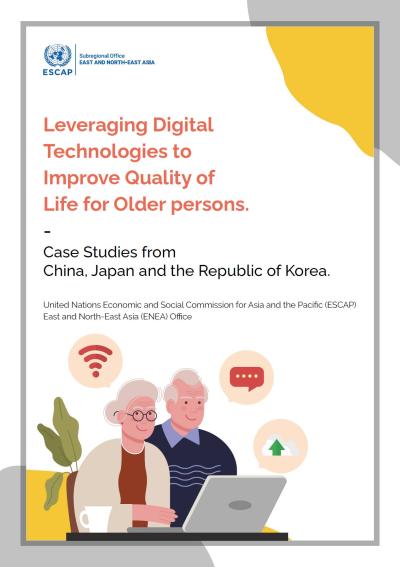
Leveraging digital technologies to improve quality of life for older persons : case studies from China, Japan and the Republic of Korea
This report reviews strategies in China, Japan, and the Republic of Korea, reviewing policies and programs aimed at improving life quality for older adults. Through case studies, it highlights trends, challenges, and lessons in creating inclusive, tech-driven ageing societies.
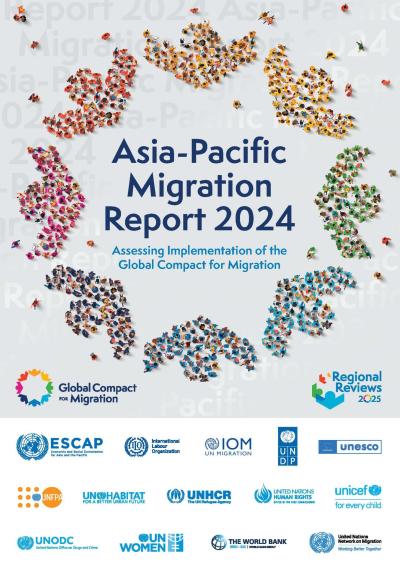
Asia-Pacific Migration Report 2024: Assessing Implementation of the Global Compact for Migration
This report aims to assess the state of GCM implementation in the region, its progress and its challenges since the first Asia-Pacific Regional Review of Implementation of the Global Compact for Migration in 2021, in which a Chair’s summary was adopted. Chapters 2 to 5 each consider clusters of GCM objectives, as presented in General Assembly resolution 73/326 and following the same groupings as in the Asia-Pacific Migration Report (APMR) 2020. These chapters open with a summary of the discussions from the first regional review of the GCM, held in 2021, drawing from the Chair’s summary. Chapter 6 provides overarching recommendations to support and accelerate GCM implementation in Asia and the Pacific. At the end of the report are annexes with information on the GCM objectives and guiding principles, references to migration in Voluntary National Reviews to the High-Level Political Forum on Sustainable Development, and GCM pledges at the level of the State or City, Municipality and Local Authority.
ESCAP population data sheet 2024
The Population Data Sheet, published annually by ESCAP, features a range of key indicators on population and development. The focus is on population size, structure and growth rates, as well as fertility, mortality and migration, at country, subregional and regional levels. The Data Sheet is a useful reference tool for researchers, policymakers and other stakeholders. The 2024 Population Data Sheet focuses on overall population and development indicators, providing updated insights for the year.

Intergenerational relations: creating a world for all ages so that no one is left behind
Populations globally are changing in fundamental ways. A result of the demographic transition, or the shift from high to low mortality and fertility rates, the slower population growth is accompanied by a shift in population age structures. Never before in history have so many people of different age cohorts been living together. This paper, prepared jointly by the five regional commissions of the United Nations, explores the social and economic challenges and opportunities of demographic shifts towards multigenerational societies across the countries covered by the five regional commissions.
Events
South-East Asia - Stakeholder Consultation for the Asia-Pacific Fifth MIPAA Review and Appraisal
Check in Meeting with Focal Points on Ageing (South and South West Asia and North and Central Asia)
Check in Meeting with Focal Points on Ageing (East and North East Asia, Pacific and South East Asia)
Blogs and Op-eds

Growing older, staying connected in the digital age

Building a future-ready society so people can live long and age well