
Policy-oriented research on population trends
ESCAP publishes reports, working papers, policy briefs and other material analyzing population trends and their policy implications in the Asia-Pacific region. The publications will guide policymakers and all stakeholders.
Latest Publication
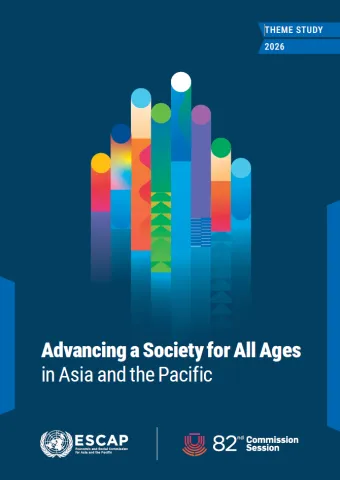
Leaving No One Behind: Advancing a Society for All Ages in Asia and the Pacific
This report examines the demographic drivers reshaping the region, analyses the implications for labour markets and the future of work, and highlights the transformative potential of healthy and active ageing. It documents the substantial economic contributions of older persons — through labour, entrepreneurship, unpaid care and social capital — and makes the case for urgently realigning employment systems, social protection and health policies with demographic realities. The report also explores pathways to women’s economic empowerment, recognizing that gender inequality compounds the vulnerabilities of ageing across the life course.
Publications
Financing for long-term care in Asia and the Pacific
The 2030 Agenda for Sustainable Development is a clarion call to leave no one behind. Older persons are among the groups in society most at risk of facing such a fate. In this context, the 2002 Madrid International Plan of Action on Ageing provides a comprehensive framework for building inclusive societies, detailing how to ensure the participation, care, and dignity of older persons. To support this process in the Asia-Pacific region, the 2013 Asian and Pacific Ministerial Declaration on Population and Development calls on member States to “Strengthen health and social protection systems to prepare for and respond to the needs of older persons … by providing an integrated continuum of care, including … long-term care and end-of-life care, and palliative care” (para 159).
In Asia and the Pacific, the number of older persons aged 60 and above is projected to more than double from 572 million in 2017 to almost 1.3 billion in 2050. Rapid population ageing in the region, combined with changing family patterns and gender roles, has increased demand for long- term care (LTC)1 for older persons.
This policy brief highlights financing options for LTC for older persons, with a focus on examples from the Asia-Pacific region. It builds on analytical studies conducted by ESCAP on LTC in China, India, Japan, Republic of Korea, Singapore and Sri Lanka
Long-term care of older persons in India
Older persons, particularly the oldest-old, are the fastest growing population segment in India and many of them require or will require long-term care in the future. The paper discusses policies on population ageing in India, such as the National Policy on Older Persons and the National Programme for Health Care for the Elderly. It further discusses the health status of older persons in India and projects future care needs. Finally, it discusses the prevailing provision of long-term care for older persons through the family as well as institutional care provided by the State, the private sector and civil society. The paper closes with policy recommendations.

Long-term care of older persons in Singapore : a perspective on the current delivery of health and long-term care for older persons in Singapore
The rapid increase of the number of older persons, particularly the oldest-old - those above 80 years - increases the need for long-term care of older persons in the Asia-Pacific region. This working paper series examines the prevailing system of provision and financing of long-term care for older persons in selected countries in the Asia-Pacific region.
Long-term care of older persons in Japan
The rapid increase of the number of older persons, particularly the oldest-old - those above 80 years - increases the need for long-term care of older persons in the Asia-Pacific region. This working paper series examines the prevailing system of provision and financing of long-term care for older persons in selected countries in the Asia-Pacific region.
Long-term care of older persons in the Republic of Korea
The rapid increase of the number of older persons, particularly the oldest-old - those above 80 years - increases the need for long-term care of older persons in the Asia-Pacific region. This working paper series examines the prevailing system of provision and financing of long-term care for older persons in selected countries in the Asia-Pacific region.

Long-term care of older persons in China
The rapid increase of the number of older persons, particularly the oldest-old - those above 80 years - increases the need for long-term care for older persons in the Asia-Pacific region. This working paper series examines the prevailing system of provision and financing of long-term care for older persons in selected countries in the Asia-Pacific region.
Events
South-East Asia - Stakeholder Consultation for the Asia-Pacific Fifth MIPAA Review and Appraisal
Check in Meeting with Focal Points on Ageing (South and South West Asia and North and Central Asia)
Check in Meeting with Focal Points on Ageing (East and North East Asia, Pacific and South East Asia)
Blogs and Op-eds

Growing older, staying connected in the digital age

Building a future-ready society so people can live long and age well